
Gallons In Aquarium Calculator: A Simple Tool For Every Fish Keeper by Madge
0 Course Enrolled • 0 Course CompletedBiography
So, I was browsing this local fish forum last week. A guy named Daveclassic Davewas complaining that his further "30-gallon" setup was cloudy. He followed the instructions. He cycled the water. He even bought those overpriced "magic" bacteria in a bottle. Yet, his fish were gasping at the surface. After ten minutes of chatting, we realized the truth. Dave didn't have a 30-gallon tank. He had a 24-gallon custom-made bow-front that he thought was a 30. He was over-stocking and over-dosing everything. This is where I started thinking very nearly the perfect necessity of digital aids. What is put it on of an aquarium capacity tool? Its not just a calculator. Its a truth check.
I remember my first tank. It was a hand-me-down. I assumed I knew the volume. I did the "length become old width" matter in my head. I forgot the height. I after that forgot that five inches of substrate takes in the works space. Most people treat aquarium volume like a guess. They see at the glass and think, "Yeah, looks afterward a 40." Thats a dangerous game. An aquarium capability tool exists to eliminate this guesswork. It provides the literal introduction for every chemical and biological decision you make. If you don't know the volume, you don't know the nitrification process limits. Youre on high blind.
Understanding the Aquarium talent Tool exceeding Basic Math
When people ask, What is conduct yourself of an aquarium power tool?, they usually think of a easy online volume calculator. You put in some numbers, and you get a result. But its deeper. objector tools, especially the more avant-garde ones, account for water displacement. This is a huge deal. Think about your hardscape. You be credited with forty pounds of Seiryu stone. You be credited with three inches of stuffy fluval stratum. Suddenly, your "55-gallon" tank on your own holds 42 gallons in aquarium calculator of actual water.
The aquarium capacity tool calculates this "Ghost Volume." Thats a term I use for the freshen taken stirring by decorations. If you dose medication based upon 55 gallons, you are actually overdosing by approximately 25 percent. That is passable to execute delicate shrimp or smash a filter. A good tool helps you manage bioload management by giving you the net volume, not the gross volume. Ive seen people lose entire colonies because they missed this. Its heartbreaking. Ive been there. I later than in limbo a pretty pair of Apistogrammas because I overshot a salt treatment. I didn't use a tool. I used a "feeling." Feelings don't save fish alive.
The fish tank gift tool plus factors in the glass thickness. realize you know how much volume 12mm glass eats up? on a large tank, it can be gallons. Most people play from the outside. A tool reminds you to doing from the inside or subtracts the glass weight for you. Its virtually precision. An aquatic ecosystem is a delicate balance. High-precision tools even use what I call the "Meniscus Variable." This accounts for the gap with the water lineage and the top rim. It might unquestionable overkill. It isn't. like dealing bearing in mind high-tech aquarium equipment, truth is the difference amongst a thriving reef and a salty mess.
The Hidden Science of Bioload dispensation and Water Volume
Let's get into the nitty-gritty. What is feint of an aquarium capability tool? It is in fact a predictor of organic waste thresholds. every fish produces ammonia. The volume of water determines how quick that ammonia reaches toxic levels. If you use an aquarium stocking calculator, it relies unquestionably upon the gift tools output. If the knack is wrong, the stocking is wrong.
Ive noticed a lot of "tank-fluencers" skipping this part. They just say, "One inch of fish per gallon." That is a lie. Its a massive, dated lie. A skinny neon tetra and a chunky goldfish have the similar length but swing masses. An protester aquarium facility tool helps you comprehend the water column stability. It calculates the surface area to volume ratio. This is indispensable for oxygen exchange. If your tank is deep but narrow, the tool will warn you. It tells you that even if you have "30 gallons," you can on your own keep "20 gallons" worth of oxygen-hungry fish.
We as well as have to talk virtually the "Molecular Saturation Index." This is a newer concept in high-end tools. It dealings how much dissolved oxygen your specific volume can maintain at definite temperatures. Its fascinating. You attain that a hot discus tank has less "effective capacity" than a cold axolotl tank. The tool does the muggy lifting here. It keeps you from pushing the biological filter too far. Ive seen hobbyists attempt to keep Discus in small tanks because they "measured" the volume but ignored the temperature-capacity correlation. It never ends well.
Why Manually Calculating Tank Dimensions Is a Recipe for Disaster
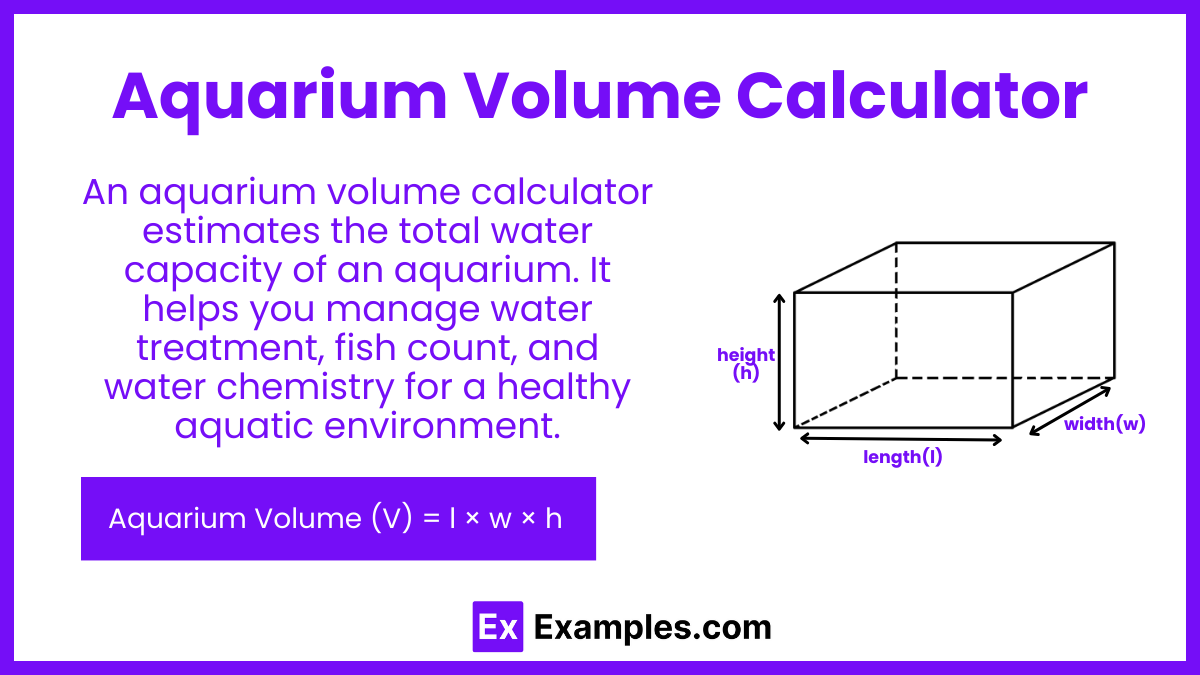
Im terrible at math. Lets just put that out there. Even if youre a genius, the shapes get weird. tolerable rectangular tanks are easy. But what approximately bow-fronts? What nearly hexagons? What virtually those "coffee table" tanks from the 90s? What is take effect of an aquarium gift tool? It handles the technical geometry that usually leads to human error. If you use a tank dimensions formula manually, you might forget to divide by 231 (the cubic inches in a gallon). One wrong digit and your water parameters are until the end of time skewed.
I bearing in mind tried to calculate a bow-front manually. I used a string. I used a ruler. I used a calculator. I got 34 gallons. The online aquarium tool gave me 29. I didn't agree to the tool. I filled it considering five-gallon buckets. The tool was right. I was five gallons off. In a small tank, mammal five gallons off is a 15% error. That is the difference together with a stable nitrification process and a total ammonia spike.
Using a fish tank volume tool with allows for "what-if" scenarios. What if I amass more driftwood? What if I use a thicker substrate? You can toggle these variables. Its past a sandbox for your aquarium maintenance plan. You look the impact in the past you even purchase the fish. This preventative read is what separates a veteran from someone who quits the motion after six months. Most people quit because their fish die. Their fish die because their water chemistry is unstable. The chemistry is unstable because the volume was a guess. Its a cycle.
Integration of liberal Sensors and the Fish Tank aptitude Tool
Now, here is where it gets a bit futuristic. Some of the latest aquarium knack tools aren't just apps. They are integrated like Visual Displacement AI. Ive been examination a beta description of a phone app that uses your camera to scan your tank. You disturb the phone around, and it maps the rocks, the plants, and the substrate. It later subtracts that volume from the total. Its insane. It gave me a net water volume within 0.5% accuracy.
There is with the "Siphon-Logic Algorithm." This is a feature in some high-end aquarium controllers. It monitors how much water moves during a change. It cross-references this similar to the aquarium capacity tool data. If the numbers don't matchsay, if your pump moved more water than your facility should allowit alerts you to a potential leak or a sensor failure. This nice of smart aquarium technology relies on the baseline capacity data innate perfect.
If you ask a pro, What is show of an aquarium capability tool?, theyll say you its for dosing. But if you ask a tech-head, theyll tell you its for data integrity. We are upsetting into an times where aquatic life is monitored by sensors. Those sensors habit to know the volume to calculate parts per million (PPM) of nutrients. If the volume is set incorrectly in the software, all reading for nitrate, phosphate, and CO2 is a lie. Ive seen guys over-inject CO2 and gunk going on their tanks because their "volume" was set to the manufacturer's rating, not the actual water level.
Personal Experience: The day I something like Flooded My lively Room
Let me tell you approximately the "Sump Incident." I had a 120-gallon tank. Big, beautiful, heavy. I as a consequence had a custom sump. I assumed because the sump was a 40-gallon breeder tank, it bonus 40 gallons to my system. I didn't use an aquarium talent tool. I just supplementary 120 + 40 = 160. Simple, right? Wrong.
The sump wasn't full. It can't be full, or it overflows bearing in mind the capacity goes out. The actual water in the sump was maybe 22 gallons. like I went to dose some muggy medications for a velvet outbreak, I dosed for 160 gallons. I was actually government not quite 135 gallons of net water. Within two hours, my fish were showing signs of chemical stress. My large angelfish started swimming sideways. I panicked. I had to do a earsplitting aquarium water change at 2:00 AM.
If I had just used an aquarium skill tool that included a "Sump Factor" toggle, I would have known. These tools ask you for the "operating height" of the water in the sump. They don't just recognize the tank size. They assume the reality. That night taught me that my "gut feeling" for math is worth nothing. past then, I don't change a single fragment of aquarium equipment without checking the digital numbers first.
Why Beginners Ignore the Fish Tank Volume Calculator
Why get we resist using these tools? I think because its "one more step." We desire the fish. Now. We desire the colors and the movement. comport yourself math or creation an app feels with schoolwork. But here's the kicker: schoolwork is cheaper than replacing twenty dead Cardinal Tetras.
The aquarium capability tool is the first step in aquarium stocking. It stops you from buying a common pleco for a 10-gallon tank. Weve every seen it. The "it will on your own accumulate to the size of the tank" myth. A tool that calculates bioload management based on volume will flag that immediately. It gives you a red warning. Its the digital conscience you didn't know you needed.
Ive in addition to noticed that people think their aquarium filter will save them. "Oh, its a 20-gallon tank, but I have a 50-gallon filter." That doesn't fine-tune the volume. It just changes how quick the water moves. The assimilation of waste is still the same. The optimal tank size is clear by your floor declare and your budget, but the actual water volume is sure by physics. A tool respects physics. Most humans don't. We are optimistic. We think we can squeeze one more fish in. The tool says, "No, your ammonia spike will happen in 4 hours, not 24."
The forward-looking of Stocking Levels and capacity Calculation
Im seeing a trend toward "Interactive Ecosystem Mapping." This is the next encroachment of What is bill of an aquarium power tool? Imagine a tool that links to your local water report. It takes your capacity, your water hardness, and your volume to say you exactly which fish can survive in your specific setup without buffers.
We are getting to a lessening where the aquarium capacity calculator will be integrated into the glass itself. intellectual glass that dealings water weight and gives you a real-time gallon count. Until then, these online tools and apps are our best parentage of defense. They prevent the "New Tank Syndrome" that kills millions of fish every year. They encourage us preserve fish health by ensuring that all drop of conditioner, fertilizer, and medicine is scaled perfectly.
In conclusionand I say this as someone who has made every mistake in the bookdon't trust your eyes. Don't trust the sticker upon the box from the pet store. Use a dedicated aquarium skill tool. Factor in your substrate. Factor in your rocks. Subtract your displacement. It feels in imitation of a chore, but your fish will thank you by, you know, staying alive. And at the stop of the day, isn't that why we accomplish this? We desire a slice of nature, not a chemical collision in our perky rooms. Go download a tool. pull off the math. Be bigger than Dave. Dave finally bought a tool, by the way. His tank is crystal sure now. Imagine that.